By the Misk Tours Team | Egypt-based travel specialists | Last verified: April 2026
An Egypt packing list has to solve two problems at once: intense heat and genuine cultural modesty. Get either wrong and the trip suffers — sunburn and dehydration on one side, feeling out of place at a mosque or bazaar on the other. This complete Egypt packing list covers exactly what to wear as a tourist, a full season-by-season breakdown, a dedicated packing guide for women, Nile cruise essentials, and the small travel essentials that separate a smooth trip from a stressful one.
Whether the itinerary runs through Cairo, Luxor, and Aswan on one of our Egypt Tour Packages, or floats between temples on a Nile cruise, this Egypt packing list will have every traveler ready in an afternoon, not a week. It’s built from what actually gets used on the ground in Cairo, Luxor, Aswan, and the Red Sea coast — not a generic warm-weather checklist copied from another country.
What is the dress code in Egypt for tourists?
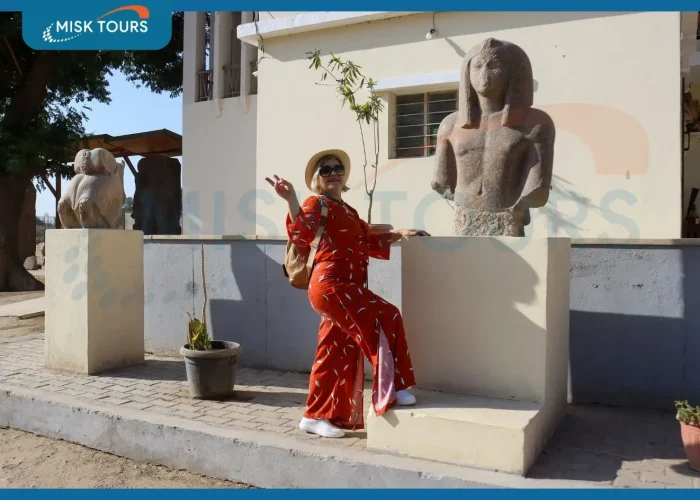
Egypt is a Muslim-majority country with a strong tradition of modest dress, and any serious Egypt packing list should reflect that before it reflects the heat. Tourists are not expected to dress exactly like local Egyptians, but dressing respectfully makes daily life noticeably easier — fewer stares in the souks, no awkward moments at mosque entrances, and a generally warmer welcome in Cairo’s Islamic Quarter and beyond. The golden rule: cover shoulders and knees in most public settings, and always carry a lightweight scarf.
General dress code rules for tourists in Egypt:
- Cover shoulders when visiting mosques, churches, and busy bazaar areas such as Khan el-Khalili.
- Cover knees at religious sites; long trousers or a maxi skirt are the easiest solution.
- Skip tight or sheer fabrics, which draw more attention in conservative neighborhoods.
- Swimwear is completely normal at Red Sea resort pools and beaches, but not on public streets.
- In Luxor, Aswan, and Cairo’s Islamic Quarter, dress a notch more conservatively than at a beach resort.
| Item | Summer | Winter | Recommended Fabric |
|---|---|---|---|
| Tops | Loose, light-coloured | Layered T-shirts | Linen, cotton |
| Bottoms | Loose trousers, maxi skirt | Chinos, light jeans | Cotton, linen |
| Outerwear | Light scarf for A/C | Light jacket, cardigan | Fleece, cotton blend |
| Footwear | Sandals + walking shoes | Trainers, comfortable boots | Leather, rubber sole |
| Headwear | Wide-brim sun hat | Light beanie for evenings | Breathable / wool |
A large, lightweight scarf earns its place in every Egypt packing list many times over. It covers shoulders at a mosque, shields the neck from the sun at the Valley of the Kings, doubles as a pillow on overnight trains, and works as a beach cover-up in Hurghada or Sharm el-Sheikh. Two is not excessive.
What should I pack for Egypt as a first-time visitor?
The single most common mistake in any Egypt packing list is planning for “hot Egypt” without accounting for real regional and seasonal swings. Cairo in January can feel genuinely cold after sunset. Aswan in August regularly exceeds 44°C. Upper Egypt — Luxor and Aswan — runs hotter and drier than the coast or Cairo all year. A season-by-season Egypt packing list resolves this in one glance.
| Season | Months | Temperatures | What to Pack | Key Keyword |
|---|---|---|---|---|
| Winter | Dec – Feb | Cairo 10–20°C / Luxor 8–24°C | Layers, light jacket, long trousers, scarf | Pack for Egypt in winter |
| Spring | Mar – May | Cairo 15–32°C / Aswan 20–38°C | Light layers, sun hat, sandals, cardigan | Spring Egypt packing |
| Summer | Jun – Aug | Cairo 25–38°C / Luxor 30–44°C | Loose linen, sun hat, sunscreen SPF 50+, sandals | Pack for Egypt in summer |
| Autumn | Sep – Nov | Cairo 20–32°C / Aswan 25–40°C | Light layers, breathable fabrics, a light rain layer | Autumn Egypt packing |
What to pack for Egypt in winter?
Winter is peak season, and the best time to visit Egypt for comfortable sightseeing, especially in Cairo and Upper Egypt — but evenings, particularly in the desert, get genuinely cold. A winter Egypt packing list should include at least one warm layer (fleece or light down), long trousers for warmth and modesty together, and a pashmina that doubles as an evening layer.
Daytime highs in Luxor and Aswan can still reach 24–26°C, so avoid over-packing heavy clothing. Coastal resorts like Hurghada run cooler in winter, so a light waterproof layer earns its spot too. The most common misstep on a winter Egypt packing list is bringing only summer clothes and being caught out by a 15°C swing between day and night.
What to pack for Egypt in summer?
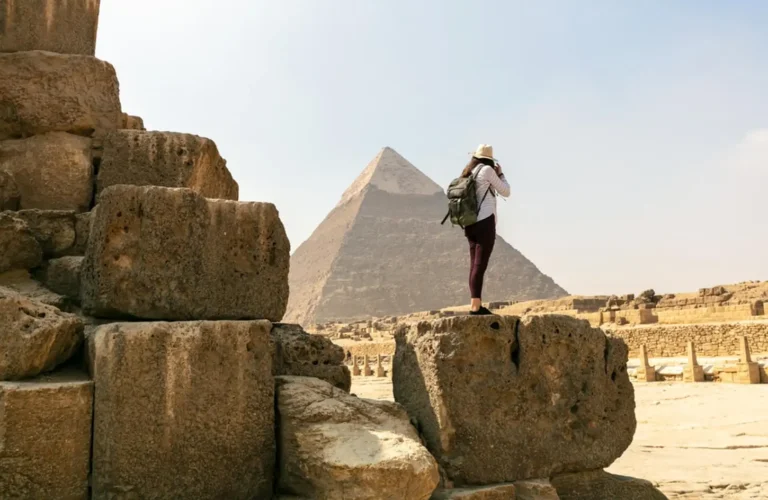
Summer is Egypt’s most intense season — Upper Egypt in July ranks among the hottest inhabited places on earth. A summer Egypt packing list is about sun protection, breathability, and hydration, not minimalism. Prioritize loose linen or cotton in light colors (white, beige, pale blue), a genuine wide-brim sun hat rather than a baseball cap, SPF 50+ sunscreen, UV-blocking sunglasses, and electrolyte sachets — heat exhaustion is a real risk at open sites like the Valley of the Kings. A reusable filtered water bottle is worth the suitcase space, and a light long-sleeve layer helps with the often-freezing air-conditioning indoors.
What to pack for Egypt in Spring?
Spring is arguably the easiest season for an Egypt packing list — temperatures are pleasant and manageable across the country. The exception is the Khamsin, a hot, dusty wind that sweeps sand across Egypt in March and April; a thin bandana or buff that pulls up over the nose and mouth handles it well.
What to pack for Egypt in Autumn?
Autumn brings a gradual easing of summer heat, though September in Upper Egypt stays extremely hot. By November, conditions are close to ideal, making it a popular shoulder season. Pack close to a summer Egypt packing list with slightly warmer options for the evenings.
What to Wear in Egypt for Women
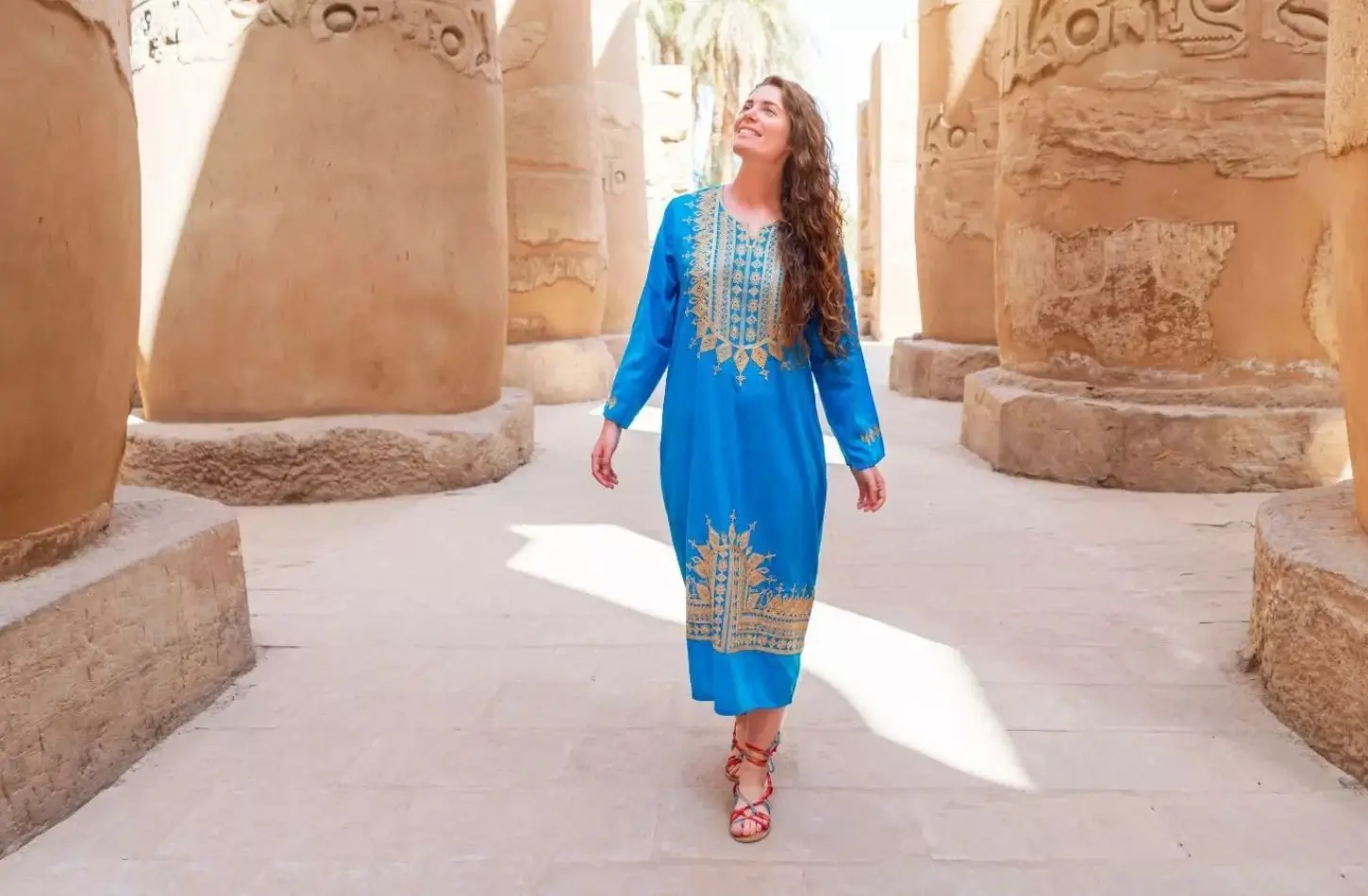
Women traveling to Egypt, solo or in a group, often ask how to balance comfort, modesty, and personal style — and a well-planned Egypt packing list for women does not require sacrificing any of the three. Egypt is generally safe and welcoming for female travelers, and dressing modestly is less about strict rules than about comfort: travelers who dress conservatively in public areas consistently report noticeably less unwanted attention
| Item | Why It’s Essential | Tips |
|---|---|---|
| Maxi dresses/skirts | Modest, cool, versatile | Loose linen or cotton; avoid sheer fabrics |
| Loose trousers | Great for temple sites and bazaars | Wide-leg linen recommended |
| Long-sleeve blouses | Cover your shoulders at religious sites | Breathable fabrics only |
| Lightweight scarf/pashmina | Head cover for mosques, sun protection | Doubles as a beach cover-up |
| Comfortable walking shoes | Uneven surfaces at sites like Karnak | Closed-toe with arch support |
| Slip-on sandals | Easy removal at mosque entrances | Flat and sturdy |
| Swimsuit + cover-up | Red Sea resorts and hotel pools | Modest cover-up for moving between pool areas |
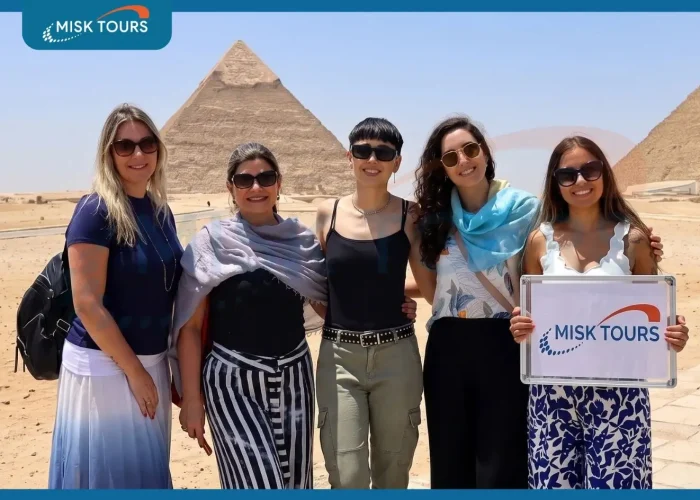
Modesty notes worth building into a women’s Egypt packing list: in Cairo’s Islamic Quarter, wear the most modest outfit on hand — long skirt or trousers with a long-sleeve top; at the Pyramids of Giza dress codes are informal but sun protection is critical; entering the Mosque of Muhammad Ali requires covered shoulders and hair, and a personal scarf is far more hygienic than a shared wrap.
At Red Sea resorts such as Hurghada or Sharm el-Sheikh, Western swimwear inside resort grounds is entirely normal.
Best fabrics for women packing for Egypt: linen (breathable, modest, easy to dress up or down), cotton gauze or muslin (extremely lightweight), and rayon or viscose (drapes well and stays cool). Skip polyester and other synthetics in warm months — they trap heat.

What to Pack for a Nile Cruise in Egypt
A Nile cruise is one of Egypt’s most loved travel experiences, drifting between Luxor and Aswan while ancient temples slide past the riverbank — and it needs its own Nile cruise Egypt packing list, distinct from a standard land itinerary. Most cruises combine shore excursions, which call for modest, practical clothing and sturdy shoes, with onboard life that can include formal dinners and sun-deck lounging, all packed from a compact stateroom.
| Category | What to Bring | Notes |
|---|---|---|
| Clothing | Smart-casual evenings, lightweight daywear | Some cruises have formal dinner nights |
| Footwear | Walking shoes, sandals, dress shoes | The deck is usually non-slip but smooth |
| Sun Protection | Sun hat, SPF 50+ sunscreen, UV sunglasses | Deck exposure is intense between 10 am and – 3 pm |
| Health & Comfort | Motion sickness tablets, hand sanitizer, insect repellent | Nile cruises are generally very calm |
| Electronics | Power bank, universal adaptor, camera | Egypt uses Type C/F sockets |
| Modesty Items | Scarf, long trousers for temple excursions | Shore excursions often include religious sites |
| Luggage | Soft-sided bag or small suitcase | Staterooms are compact |
A smart approach to Nile cruise packing also leaves room to come home with something: use a soft-sided bag rather than an oversized hard case, pack a separate small daypack for excursions, check the itinerary for formal nights, and bring a light rain layer for cooler upper-deck evenings between October and February.
Sunscreen matters most on deck between Luxor and Aswan, where the Nile Valley forms a heat corridor with little shade. Onboard laundry is common, so pack lighter and re-wear versatile pieces. For electronics, Egypt runs on Type C/F sockets at 220V; most modern devices are dual-voltage, but a universal adaptor and a power bank are non-negotiable for long shore days.
Egypt Travel Essentials Checklist
Beyond clothing, every Egypt packing list needs a core set of travel essentials — whether the trip is a long weekend in Cairo, a two-week Luxor-and-Red-Sea combination, or a luxury Nile cruise.
Documents and money:
Most nationalities can get an Egyptian e-visa online before travel; carry a printed copy alongside the digital one. The Egyptian Pound (EGP) is the local currency, and while ATMs are widely available in Cairo and major tourist areas, arriving with some cash covers tipping and small purchases. USD is also widely accepted as tip currency.
Health and medication:
Pack prescriptions in original packaging with a copy of the prescription. Stomach upsets are the most common travel issue, so rehydration sachets, an anti-diarrheal, and antiseptic wipes belong on every Egypt packing list. Cairo has good medical facilities, but access is more limited in remote areas — comprehensive travel insurance is essential, particularly for anyone venturing beyond the main tourist circuit into the Western Desert or more remote parts of Upper Egypt.
Tech essentials:
- A universal Type C/F travel adaptor
- A portable power bank for all-day excursions
- Offline maps downloaded in advance
- A local SIM (Vodafone Egypt or Orange Egypt) for inexpensive data at Cairo Airport
- A waterproof phone case for cruise-deck time and Red Sea snorkeling
Small items that make a real difference:
A small padlock for lockers or luggage zips, a reusable shopping bag, clothes pegs for hand-washed laundry, a compact umbrella for surprise winter rain in Alexandria or Cairo, and a good book for the long overnight trains that connect much of an Egypt multi-city tour. For more on planning the trip itself, see our Egypt travel tips.
Suitcase and Packing Cubes
How the bag is organized matters almost as much as what goes inside it. Packing cubes keep a mixed Egypt packing list — modest daywear, swimwear, one smart-casual outfit, and a stack of scarves — from turning into a jumbled suitcase halfway through a multi-city trip. A rough split that works well: one cube for tops, one for bottoms, one for underwear and swimwear, and a flat pouch for scarves and the sun hat so it doesn’t get crushed. A separate small pouch for electronics and cables saves time at airport security and hotel check-ins alike. For anyone combining a Cairo stay with a Nile cruise, packing cubes also make it easy to pull out only what’s needed for the cruise portion without unpacking the entire case
Final Packing Tips for Egypt
A few closing packing principles that experienced Egypt travelers repeat almost universally: pack light and leave room, since Khan el-Khalili in Cairo and the Luxor market are exceptional for scarves, jewelry, and cotton clothing;
stick to neutral colors, since beige, white, and pale blue hide sand and dust better than dark shades; bring two pairs of comfortable walking shoes, since sites are large and days are long; never plan a suitcase around only a swimsuit and shorts unless the trip is strictly a Red Sea resort stay; and invest in real sun protection before departure, because Egyptian sun is intense even in winter.
Frequently Asked Questions: Egypt Packing List
Do women need to cover their hair in Egypt?
Only inside mosques and some Islamic religious sites. Most provide wraps, but a personal scarf is more hygienic and practical. Elsewhere, covering hair is not required for tourists, though it can ease attention in more conservative neighborhoods.
What is the best luggage for an Egypt trip?
A medium hard-shell suitcase (around 20–25kg) with a compact daypack suits most itineraries. For a Nile cruise, switch to a soft-sided suitcase or duffel, since hard-shell cases are awkward in compact staterooms, and add a small lockable daypack for site visits.
Can I buy toiletries in Egypt?
Yes — Cairo, Alexandria, and resort towns have pharmacies and supermarkets with a reasonable range. Quality SPF 50+ sunscreen can be pricier and less varied, so it’s worth bringing from home, along with any specific prescriptions or skincare.
Is there anything I should not bring to Egypt?
Skip revealing clothing for non-resort areas and unnecessary valuables. Drones are tightly regulated and often confiscated at airports, so check current rules before packing one; alcohol is available through licensed outlets locally, so there’s little reason to carry large quantities.
How much luggage should I bring to Egypt?
For a 7–10 day trip, one 20–23kg checked bag plus a daypack is the sweet spot most experienced travelers land on. Traveling lighter helps with internal flights, Nile cruise stateroom storage, and any desert camping — and leaves room for market finds.
What currency should I bring to Egypt?
The Egyptian Pound (EGP) covers most day-to-day spending — small shops, local restaurants, and tipping. Small-denomination USD ($1 and $5 notes) is widely accepted for tips. ATMs are common in major cities and tourist areas, and exchanging money after arrival generally gets a better rate than exchanging before the trip.
Ready to Plan the Trip?
Egypt rewards travelers who arrive prepared. A thoughtful Egypt packing list means less time managing logistics and more time watching the sun rise over the Valley of the Kings, drifting quietly down the Nile, or standing in front of the pyramids at dusk. Pack smart, and let one of the best travel agencies in Egypt handle the rest — from Nile cruise bookings to private custom Egypt tours and everything in between. Get the packing right, and the only thing left to plan is which sunrise to watch first.