By the Misk Tours Team | Egypt-based travel specialists | Last verified: July 2026
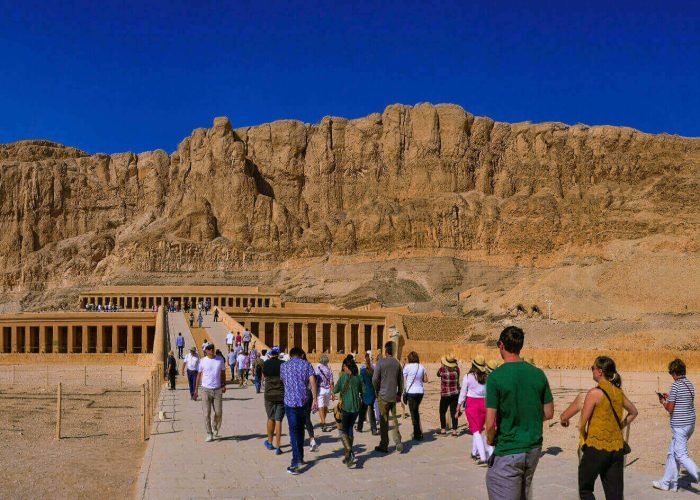
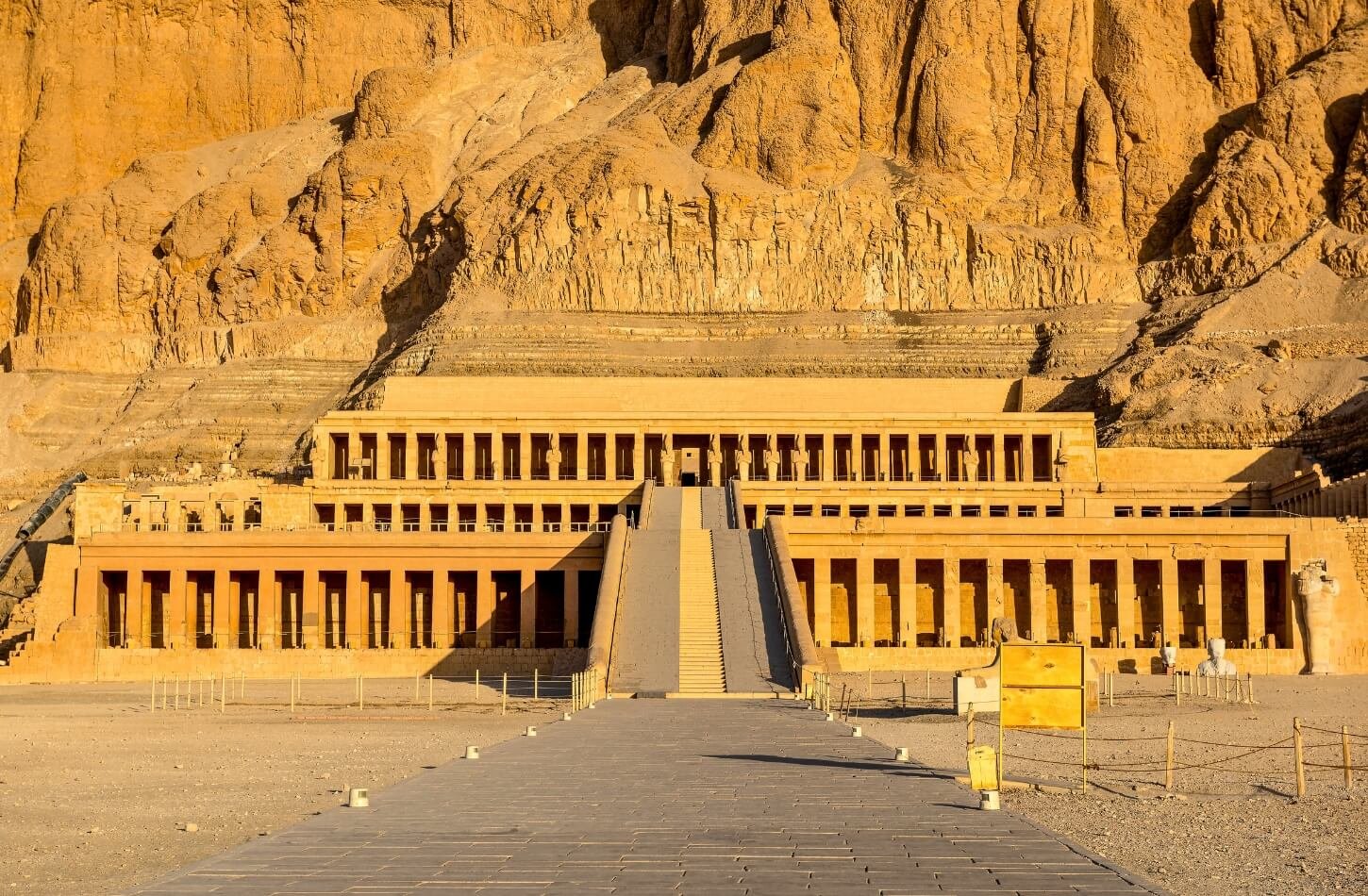
The desert cliffs at Deir el-Bahari do something no other site on Luxor’s West Bank manages: they go completely silent, then suddenly open onto three vast limestone terraces rising straight out of the rock, as if the mountain itself had been carved into a stairway for a god. That is the Hatshepsut Temple, and it was built by a woman who was never supposed to rule Egypt at all, then ruled it so well that her enemies spent a generation trying to erase her name from the walls you are about to see.
This guide is the one we wish every guest had before stepping off the coach: current 2026 ticket prices, opening hours, the history behind the reliefs, a comparison against the Valley of the Kings and Karnak Temple, a sample one-day itinerary, and the small details, from where to stand for the best photo to how many stairs you will actually climb, that turn a rushed twenty-minute stop into the highlight of a Luxor trip.
What Is the Hatshepsut Temple?
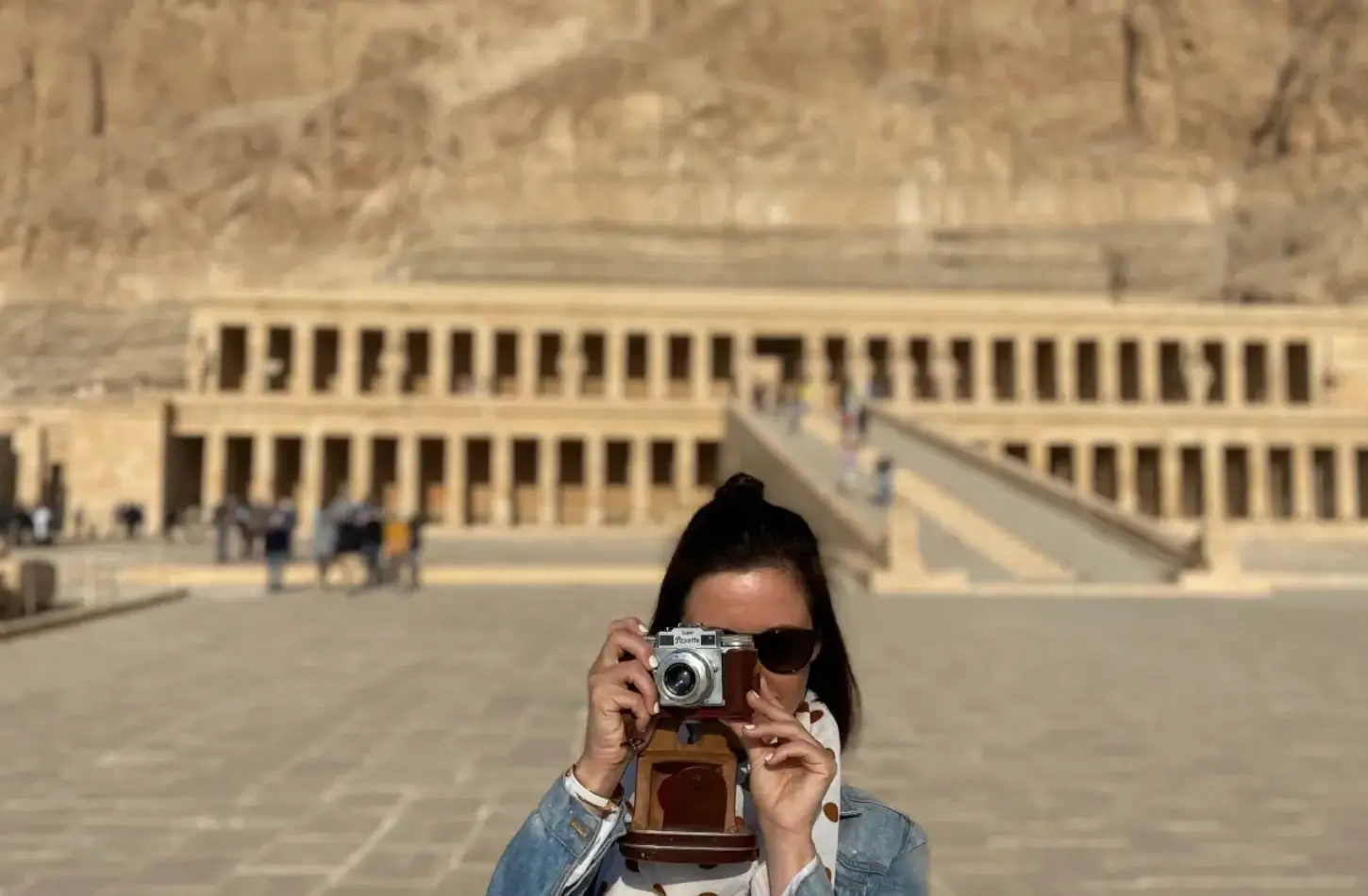
The Hatshepsut Temple, also known as the Mortuary Temple of Hatshepsut or Djeser-Djeseru (“Holy of Holies”), rises out of the desert floor in three long colonnaded terraces that appear to grow directly from the cliff behind them. It sits at Deir el-Bahari, on Luxor’s West Bank, roughly five kilometers from the Nile and a short drive from the Valley of the Kings.
Unlike the massing and columns of Karnak Temple or Luxor Temple on the East Bank, it was never meant to be a place of worship for the public. It was a mortuary temple, a place where priests performed rituals to sustain Hatshepsut’s spirit in the afterlife, and a monument to a reign that Egypt’s later rulers tried very hard to erase.
Who Was Queen Hatshepsut?
Hatshepsut began as regent for her young stepson Thutmose III around 1479 BCE, then took the full title and regalia of pharaoh herself, ruling as one of Egypt’s most successful monarchs for roughly two decades. Her reign was marked by peace, trade, and an ambitious building program, the centerpiece of which is the temple that still bears her name.
To legitimize a role no woman had held in her own right, Hatshepsut had herself depicted in official art wearing the traditional false beard and kilt of a male pharaoh, a visual claim to authority rather than a disguise. She commissioned a famous trading expedition to the land of Punt, believed to lie along the Horn of Africa, and returned with incense trees, ebony, gold, and myrrh, all of which are carved in detail on the temple’s walls. After her death, Thutmose III ordered many of her statues and cartouches destroyed, an act of erasure that makes the surviving reliefs at the temple even more valuable to historians today.
A Brief History & Timeline
| c. 1479–1458 BCE | Construction under Hatshepsut’s reign, designed by Senenmut |
| c. 1458 BCE onward | Thutmose III’s campaign to remove Hatshepsut’s name and images from the temple |
| 6th century CE | Coptic monks convert part of the site into a monastery, giving the area its modern name, Deir el-Bahari (“Monastery of the North”) |
| 1881–1900s | Rediscovery and early excavation by Egyptologists, including Édouard Naville |
| 1961–present | Ongoing restoration by a joint Polish-Egyptian archaeological mission, responsible for most of the reconstruction visible today |
| Today | One of Egypt’s most visited archaeological sites, protected under UNESCO’s Theban Necropolis listing |
Architecture: Inside the Three Terraces
The genius behind the Hatshepsut Temple was the royal architect Senenmut, who designed it to echo and surpass the older, two-terraced mortuary temple of Mentuhotep II next door. The result is one of the most distinctive buildings to survive from the ancient world, and one that architectural historians regularly point to as centuries ahead of its time in its use of symmetry and negative space.
Three broad terraces connected by ramps
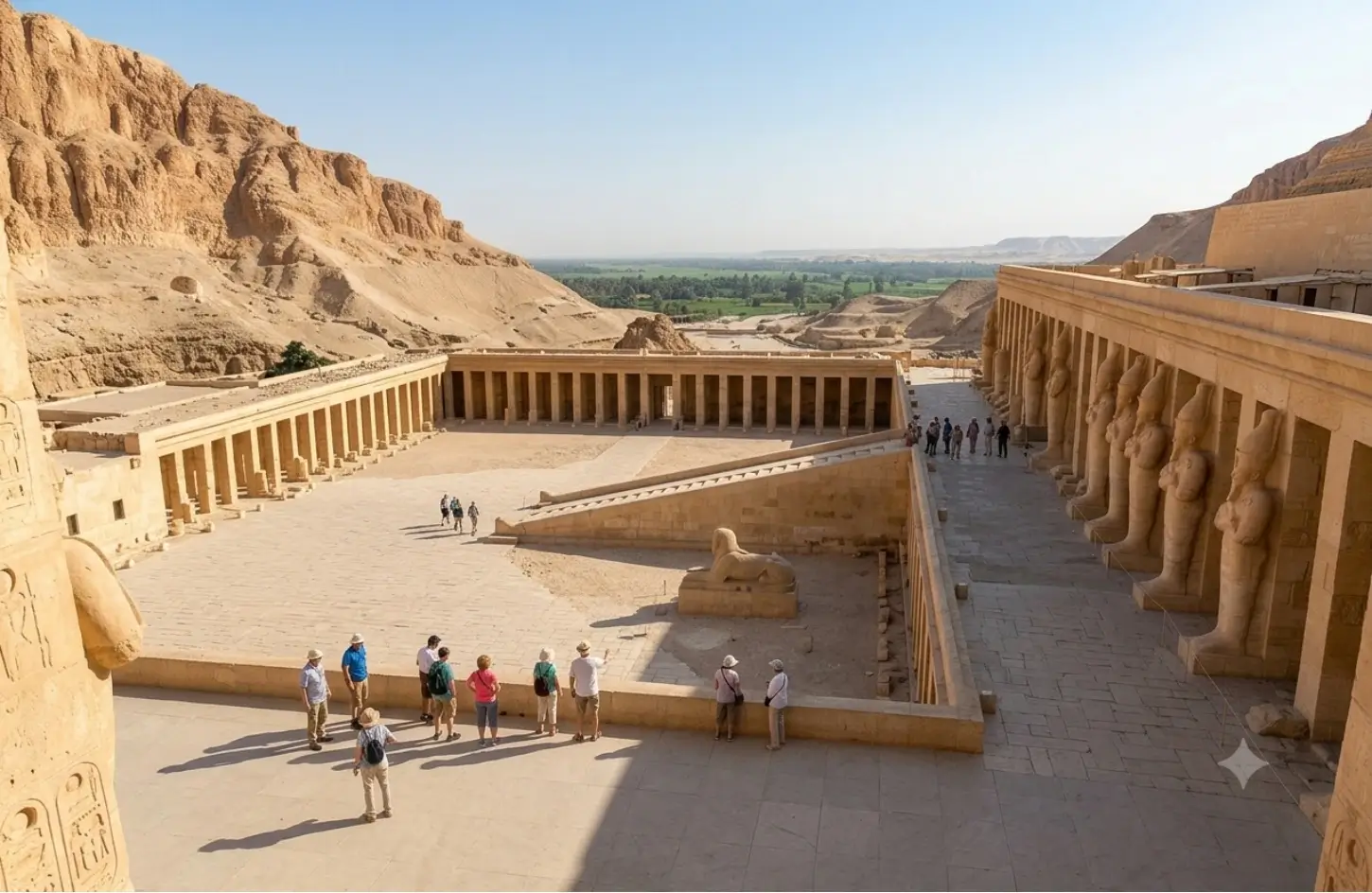
Each level of the temple is fronted by a colonnade of square pillars, and each terrace held its own garden, pools, and imported incense trees in antiquity, a green oasis built deliberately against the bare cliff.
Reliefs of the Punt expedition
The second terrace carries the temple’s most famous carvings: ships loading incense trees, exotic animals, and foreign rulers paying tribute to Hatshepsut, including a widely reproduced portrait of the Queen of Punt.
The Chapel of Hathor and the Chapel of Anubis
Side chapels on the lower terraces are cut deep into the rock and decorated with columns carved as the head of the goddess Hathor, along with vividly preserved ceiling paintings.
The upper terrace and sanctuary
The top level holds the temple’s sanctuary, cut directly into the cliff face, along with a solar altar dedicated to Amun-Ra and a row of Osiride statues of Hatshepsut standing guard along the facade.
Hatshepsut Temple vs Valley of the Kings vs Karnak Temple
If you are deciding how to split limited time across the West and East Banks, here is how the three sit side by side:
| Site | What You See | Time Needed | Best For |
|---|---|---|---|
| Hatshepsut Temple | Cliff-carved terraces, painted reliefs, no underground tombs | 60–90 min | Architecture, photography, one pharaoh’s story |
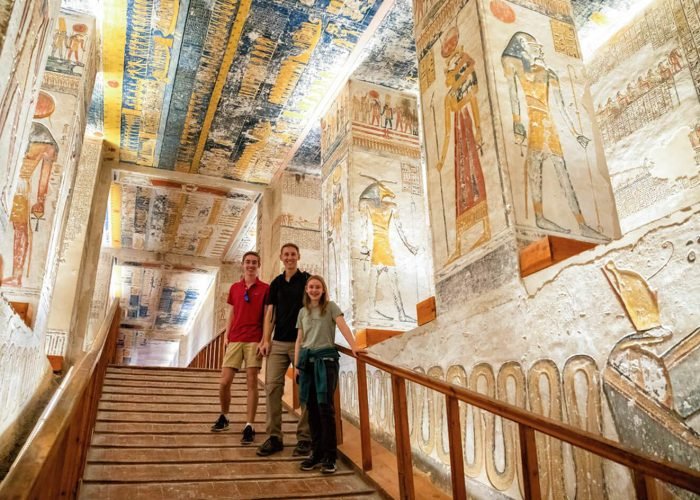
| Valley of the Kings | Underground painted royal tombs, including Tutankhamun’s | 1.5–2 hrs | Tomb art, burial customs, famous pharaohs |
| Karnak Temple | Egypt’s largest temple complex, giant hypostyle hall of columns | 2–3 hrs | Scale, the Sound & Light Show, East Bank day |
Hatshepsut Temple Tickets & Prices (2026)
Entry to the temple is priced separately from the Valley of the Kings and Karnak Temple, so budget for it as its own ticket line. Prices are set by Egypt’s Ministry of Tourism and Antiquities and change periodically, so treat the figures below as planning estimates rather than fixed numbers.
| Visitor Type | 2026 Price |
|---|---|
| Foreign adult | ~450 EGP (~$9–$10 USD) |
| Foreign student (valid ISIC card) | ~225 EGP |
| Egyptian / Arab nationals | Discounted local pricing |
| Children under 6 | Free |
Tickets are sold at the site’s own ticket window, not at the general Luxor West Bank pass counter, so plan a few extra minutes. Travelers visiting several sites in one trip sometimes ask about the Luxor Pass, a paid multi-day pass covering most West and East Bank monuments; it is rarely cheaper than paying per site unless you plan to visit five or more locations, including premium tombs, within its validity window. If your trip includes several temples, our guide to Egypt on a budget breaks down which combined passes are worth buying and which are not.
Hatshepsut Temple Opening Hours
The temple keeps seasonal hours tied to daylight and heat :
| Season | Hours |
|---|---|
| October – April | 6:00 AM – 5:00 PM |
| May – September | 6:00 AM – 6:00 PM |
Arrive at opening. Tour buses from Nile cruise ships and Luxor hotels typically reach the site between 8:30 and 10:00 AM, so the first ninety minutes after the gates open are the only realistic window for photographing the temple without crowds in every frame.
Best Time to Visit the Hatshepsut Temple
The best time to visit the Hatshepsut Temple is between October and February, when daytime highs in Luxor stay in a manageable range and the unshaded terraces are not punishing to walk. Our full breakdown of the best time to visit Egypt covers how this compares across the whole country, and if you are traveling in the shoulder season, our guide to Egypt in November has specific advice for that month.
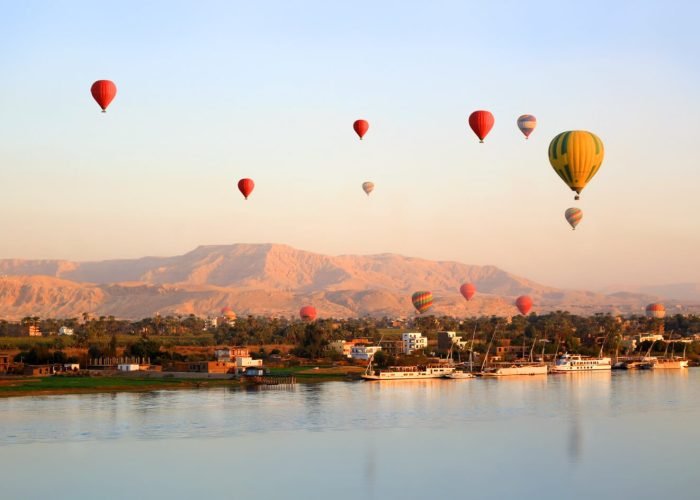
Within any season, morning is non-negotiable. The terraces have almost no shade, and by midday the limestone reflects heat back at anyone still walking around. Book the tour for the earliest available slot, even if that means an unpleasant hotel pickup time. Sunrise hot air balloon flights over the West Bank, which pass directly above the temple, are also most reliable in the cooler months when winds are calmer.
How to Get to the Hatshepsut Temple
It sits on Luxor’s West Bank, across the Nile from the main city. Most visitors reach it as part of a private vehicle itinerary that also covers the Valley of the Kings and the Colossi of Memnon, since taxis alone will not take you inside the site itself. From central Luxor, the drive is roughly 20 to 25 minutes depending on the bridge crossing used and traffic near the ferry terminals. Travelers based on a Nile cruise ship typically start the day with a short crossing by ferry or private boat directly from the vessel.
What to See Inside: Reliefs, Chapels & the Punt Expedition
Once inside, a few details are easy to miss if you are moving quickly:
- The Punt reliefs on the second terrace, showing the Queen of Punt in a much-discussed and unusually naturalistic portrait, one of the earliest realistic depictions of an individual body type in Egyptian art
- The Birth Colonnade, depicting Hatshepsut’s claim of divine birth from the god Amun
- The restored Hathor-headed columns inside the chapel on the southern side
- Damaged cartouches where Thutmose III’s agents chiseled out Hatshepsut’s name and image after her death
- The row of Osiride statues on the upper terrace, several of which still show traces of original paint pigment
Photography without flash is permitted throughout the site, though tripods require a separate paid permit from site staff.
Best Photo Spots & Photography Tips
The classic wide shot is taken from the base of the ramp leading to the first terrace, low enough to capture all three levels stacked against the cliff face. For a quieter composition without crowds in frame, the far right edge of the lower terrace works well before 8:00 AM. If you want the temple’s full symmetry, the elevated viewpoint partway up the entrance ramp on the neighboring hillside, used by many professional tour photographers, gives the cleanest frontal angle. Midday sun flattens the reliefs and washes out the limestone in photos, so treat the first and last hour of opening as the only genuinely good photography windows here.
Nearby Attractions on Luxor’s West Bank
The Hatshepsut Temple is rarely visited alone. Most itineraries combine it with:
- The Valley of the Kings, home to more than 60 royal tombs including Tutankhamun’s, roughly 1.5 km away
- The Colossi of Memnon, two seated statues visible from the road on the way back to the Nile
- Medinet Habu, the well-preserved mortuary temple of Ramses III
- An alabaster factory stop on the road back, where local artisans demonstrate hand-carving techniques still used since pharaonic times
- On the East Bank, Karnak Temple and Luxor Temple round out a full day across both sides of the river
Sample One-Day West Bank Itinerary
| Time | Stop |
|---|---|
| 06:00 | Hatshepsut Temple at opening, before the coach groups arrive |
| 07:15 | Colossi of Memnon, a five-minute photo stop |
| 07:30 | Valley of the Kings, three included tombs plus optional Tutankhamun’s tomb |
| 09:30 | Alabaster factory stop, short break with shade and refreshments |
| 10:15 | Return to Luxor for lunch, or continue to Medinet Habu for a quieter, less-visited final stop |
Best Hatshepsut Temple Tours from Luxor
The most efficient way to see the Hatshepsut Temple is as part of a guided West Bank morning rather than as a standalone stop. Our Luxor tour packages bundle it with the Valley of the Kings and Colossi of Memnon, include an Egyptologist guide, and handle entrance tickets so you are not queuing in the sun. Travelers combining Luxor with a full Nile itinerary tend to book one of our Egypt classic tours, which pair a Hatshepsut Temple morning with a Nile cruise onward to Aswan.
If your dates or interests do not fit a set departure, our team can build a custom Egypt tour around your own pace, adding it to a private West Bank day exactly where you want it.
Accessibility & Practical Considerations
This site involves more walking and stairs than most Luxor sites. Visitors should expect a long ramp between the lower and upper terraces, uneven original stone in places, and no elevator access to the top level. A small electric tram covers the flat approach from the parking area to the base of the temple, which helps with the longest single stretch, but travelers with limited mobility should budget extra time and consider stopping at the first or second terrace rather than attempting the full climb.
There is one small shaded rest area near the ticket office; beyond that, shade is minimal until you are inside the chapels themselves.
Tips for Visiting the Hatshepsut Temple
A short checklist for your visit:
- Wear closed-toe shoes; the ramps and terraces are uneven in places
- Bring at least 1.5 liters of water per person, there is minimal shade on-site
- Sunscreen and a hat are non-negotiable between April and October
- Budget 60 to 90 minutes on-site if combining it with other West Bank sites
- Use the electric tram from the parking lot rather than walking the full approach in summer heat
- For broader planning, our Egypt travel tips page covers visas, packing, and etiquette beyond this one site
Interesting Facts About the Hatshepsut Temple
- Hatshepsut was only the second confirmed female pharaoh to rule Egypt in her own right, not merely as a regent or consort
- Her chief architect Senenmut also held the unusual role of tutor to Hatshepsut’s daughter, and some Egyptologists believe the two were personally close
- The temple’s original gardens were planted with actual myrrh trees brought back from the Punt expedition, among the earliest recorded examples of tree transplantation in history
- Much of what visitors see today is 20th and 21st century reconstruction; large sections collapsed or were deliberately destroyed and have been carefully rebuilt from original fragments
- The Arabic name Deir el-Bahari has nothing to do with Hatshepsut herself, it refers to the Coptic monastery later built on the site
Frequently Asked Questions
How much are Hatshepsut Temple tickets in 2026?
Expect around 450 EGP for a foreign adult, with roughly 50% off for students holding a valid ISIC card. Prices are set by Egypt’s antiquities ministry and can change without notice.
What are the Hatshepsut Temple opening hours?
The temple opens at 6:00 AM year-round, closing at 5:00 PM from October to April and 6:00 PM from May to September.
How long should I spend at the Hatshepsut Temple?
Most visitors need 60 to 90 minutes to see all three terraces and the main reliefs without rushing.
Is the Hatshepsut Temple worth visiting?
Yes. It is one of the few surviving monuments built for a female pharaoh, and its cliff-cut design is unlike anything else on Luxor’s West Bank.
Can I visit the Hatshepsut Temple and Valley of the Kings in one day?
Yes, they sit roughly 1.5 km apart and are almost always visited together on a half-day West Bank tour.
How do I get from Luxor to the Hatshepsut Temple?
Most travelers cross the Nile by private vehicle as part of a West Bank tour; independent taxis can drop you nearby but not inside the site.
Is the temple wheelchair or stroller accessible?
Partially. A tram covers the flat approach, but the ramps between terraces and the uneven original stone limit full access to the upper levels.
Why is Queen Hatshepsut’s image damaged in parts of the temple?
Her stepson Thutmose III ordered many of her statues and cartouches destroyed after her death to erase her legacy as pharaoh.